Dear Charitable Trust,
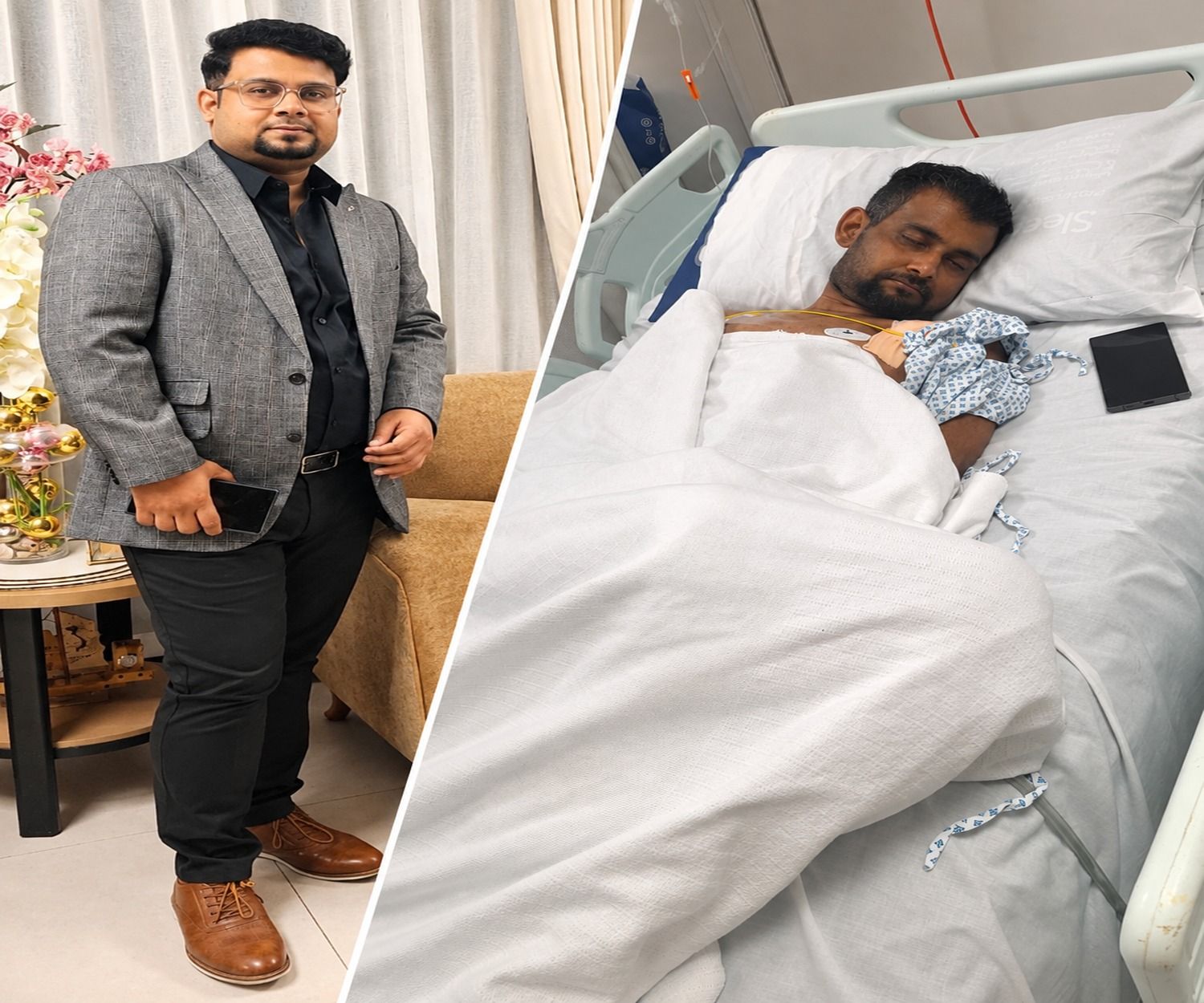
A Year of Fighting: Roger's Story , My name is Mrs. Irene Roger, and I am writing to you about my husband, Roger.
It started in October 2025 with a heart attack that came out of nowhere. Roger was just 39 years old. In that same hospital visit, doctors discovered he also had diabetes — a diagnosis he hadn't even known he was carrying. We were frightened, but we told ourselves: we caught it, we'll manage it, we'll move forward.
Then in January 2026, we learned his heart's electrical system had failed completely. He needed a pacemaker. We held onto hope that this would be the turning point — that we could finally exhale.
We were wrong. Within weeks, Roger could barely breathe. By March, doctors found that his heart's pumping strength had collapsed from nearly normal to severely weak. Heart failure. Something no one had expected from a "successful" pacemaker surgery. Through April and May, we were in and out of hospitals as fluid kept building in his body, needing to be drained again and again. Then, on 23 May, an echocardiogram found a blood clot inside his heart itself — large enough to cause a stroke at any moment. He was rushed into the ICU.
In June, at Aster Hospital Mankhool, in cardiogenic shock, doctors finally found the deeper problem: his original pacemaker leads were themselves damaging his heart. On 26 June, Roger underwent surgery for a CRT-D — an advanced, expensive device meant to save a failing heart. We believed, finally, that we had found the answer.
Few days later, that hope was taken from us too. The device had become infected. To save his life, it had to be surgically removed on 6 July — we'd placed everything we had into it.
Roger was kept alive on a temporary pacemaker through more than a month of antibiotics, while his body kept fighting: anemia, kidney injury, liver dysfunction, sepsis, fluid around his lungs.
On 22 August, Roger received a new permanent pacemaker — not the advanced CRT-D device again, because we could not bear that cost a second time. We were grateful simply that he had lived to reach that day. But he has not left the hospital since June. And today, as I write this, he is back in the ICU, on dialysis, his kidneys failing, still fighting.
And now, his treating interventional cardiologist, Dr. Naveed Ahmed, has told us that Roger's heart has reached a point beyond repair — that a heart transplant is now the only solution left to save him, and the only way to stop his other organs from failing one by one, as they already have begun to with his kidneys on dialysis. This is no longer a hope we are holding onto quietly; it is a medical necessity his own doctor has put in writing, and it is the reason I am reaching out to you again, with even greater urgency than before.
Our insurance ran out long ago. Since 22 June, every single day of his care has been billed directly to us. The hospital's own statement shows AED 549,390 still outstanding — and it grows every day he remains in the ICU. We have paid what we could. We have nothing left to give, and the cost of the transplant process now ahead of him is far beyond anything we could ever hope to raise alone.
I am not asking for help because we failed to seek care, or failed to plan. I am asking because Roger's illness has, at every single turn, been more serious and more expensive than any family could have prepared for. Every discharge summary, every report, every bill — I can provide all of it, and I would welcome your team speaking directly with his doctors or the hospital's finance department to verify every word of this.
Roger is my husband. For a year, I have watched him fight — recover a little, only to face something worse. Now he is being asked to fight for his life in a way I never imagined: to wait and hope for a heart transplant that could truly give him his life back, while his other organs hang in the balance. I am asking for your help because I have run out of every other option, and because his treatment cannot wait while I keep searching. Whatever you are able to do would give him a real chance to keep fighting, and it would mean more to our family than I can put into words.
Thank you for reading Roger's journey. I humbly request your consideration for our appeal...
Associated Campaign
Since 2020, the Pakistan Medical Centre has supported over 200,000 people from 128 nationalities. As the GCC’s first non-profit healthcare center of its kind, it provides subsidized care through 37+ specialties. Through the “Sponsor a Patient” initiative, a donation of AED 250 helps patients access essential medical treatment and care.